


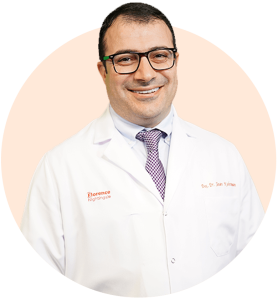
Prof. Dr. Sinan KAHRAMAN
Orthopedics and Traumatology Specialist
Treatments
Prof. Dr. Sinan KAHRAMAN and her expert team safely perform treatments and achieve successful results.
Scoliosis Surgery
The treatment of scoliosis varies depending on the degree of curvature and the child’s age. In adolescents, curvatures between 20 and 40 degrees are typically managed with bracing, while curvatures greater than 40 degrees are usually treated with surgery.
Kyphosis Surgery
Kyphosis surgery can be evaluated in two main groups: children and adults. In children, particularly during adolescence, surgery is generally considered if the curvature exceeds 75–80°, if there is chronic back or lower back pain, and if the condition does not respond to physical therapy.
In adults, surgical treatment is recommended when kyphosis disrupts spinal balance and leads to chronic back or lower back pain.
Knee Replacement Surgery
In cases where the knee joint has experienced complete cartilage loss, resulting in irreversible damage and advanced osteoarthritis, a new knee joint is created using metal components.
Hip Replacement Surgery
This is a treatment applied in cases of advanced osteoarthritis where the hip joint is severely damaged and unable to perform its normal functions.
It is performed by replacing both the head of the femur and the hip socket with metal components.
Spinal Stenosis Surgery
Spinal canal stenosis is defined as the narrowing of the spinal canal to less than 100 mm².
Patients often feel the need to sit after walking a certain distance. Symptoms may include numbness, tingling, and weakness in the legs.
Knee Arthroscopy
In cases of a meniscus tear, knee arthroscopy may be performed to repair the torn meniscus or to remove the damaged portion.
Knee arthroscopy can also be used for anterior cruciate ligament (ACL) reconstruction or cartilage repair procedures.
Shoulder Arthroscopy
Shoulder arthroscopy is performed in conditions such as frozen shoulder, rotator cuff tears, shoulder impingement syndrome, and recurrent shoulder dislocations.
The procedure is carried out by entering the shoulder joint through 2–3 small incisions, using a camera and specialized instruments to perform the necessary interventions.
Meniscus Tear Surgery
Meniscus tear is the rupture of the menisci within the knee joint, typically caused by sports injuries or age-related degeneration.
It is a surgical procedure performed by inserting a camera and specialized instruments into the joint through two small incisions.
Neck Hernia Surgery
Cervical disc herniation is a condition in which the discs in the neck region compress the spinal cord or nerve roots, leading to severe pain in the arms, along with numbness, tingling, and loss of strength.
Achilles Tendon Rupture Surgery
Achilles tendon injury occurs when the Achilles tendon, which attaches to the heel bone, ruptures due to excessive strain. In acute tears, the tendon ends are primarily sutured end-to-end.
The leg is immobilized in a cast for 6 weeks. This is followed by 3 weeks of support with a walking boot that gradually allows weight-bearing. By the end of the third month, the patient can typically return to sports activities.
Anterior Cruciate Ligament Tear Surgery
The anterior cruciate ligament (ACL) is one of the key ligaments that prevents the tibia from moving forward in the knee joint and provides stability. Tendons harvested from the patient using a minimally invasive (closed) technique are used to create a new ligament.
Through an arthroscopic procedure, a new ligament reconstruction is performed by creating tunnels within the knee joint.
Non-surgical treatment of osteoarthritis.
Non-surgical osteoarthritis treatment involves repairing damaged cartilage by using cells obtained from adipose (fat) tissue or bone marrow. These cells are processed through various methods and injected into the damaged cartilage area to promote healing.
Leg Lengthening Surgery
Limb lengthening surgery is primarily performed to lengthen an extremity that has become shorter due to trauma, tumors near growth plates, or infections.
Additionally, for cosmetic purposes, height-lengthening procedures can be performed for women shorter than 150 cm and men shorter than 160 cm.
Herniated Disc Surgery
Lumbar disc herniation is defined as the condition in which the spinal discs compress the spinal canal or the nerve roots.
Herniated disc surgeries are generally performed using minimally invasive (closed) techniques and can be carried out with microscopic or endoscopic methods.